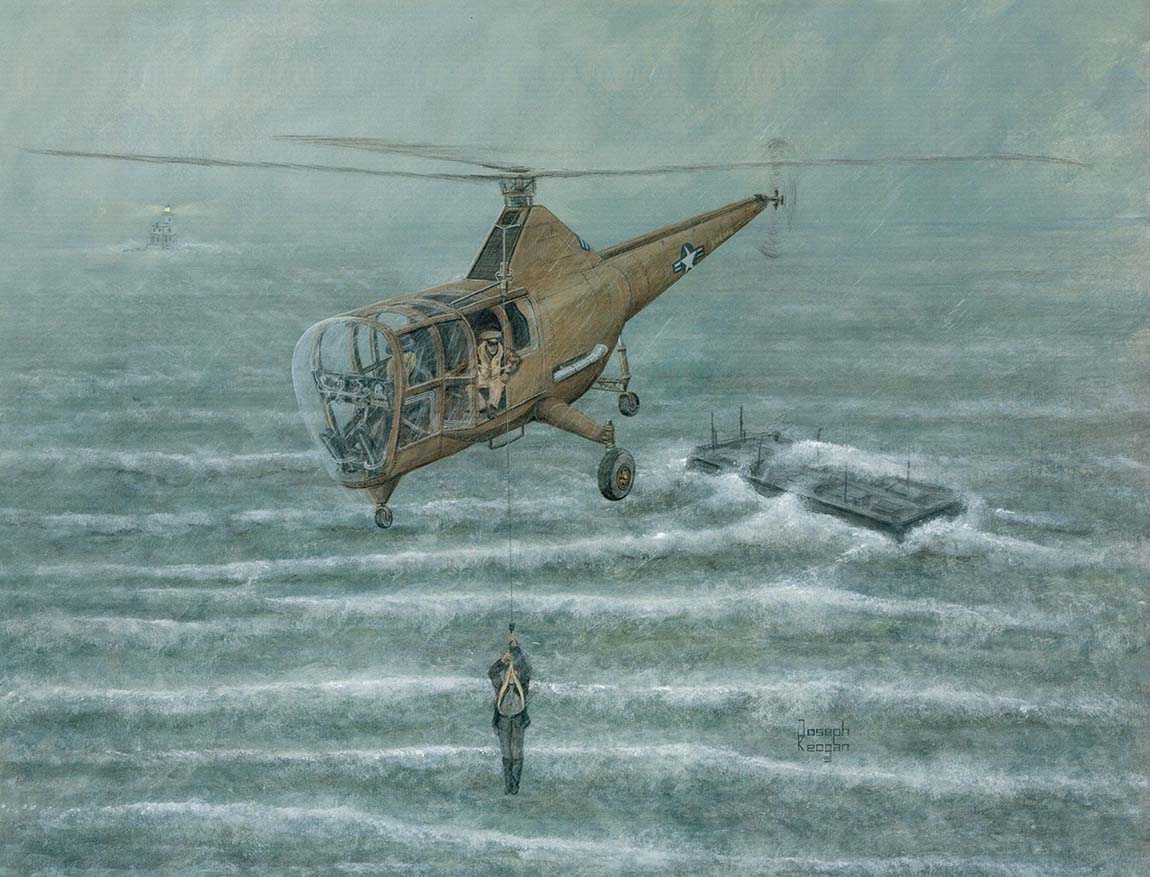
News reports from that day captured the intensity of the storm. All aircraft at LaGuardia Airport in Queens, New York were grounded due to the water that had washed in from Flushing Bay, flooding over half of the airfield. In Boston, 7,000 soldiers returning from overseas duty in World War II were held in their troopships rocking back and forth in the outer harbor and unable to dock because of the fierce winds. And in Fairfield, Connecticut, two men had been stranded for 16 hours on a grounded oil barge that was slowly breaking apart as it was pounded by destructive waves.
Until then, helicopters had been used for military and some civilian lifesaving missions during the latter part of World War II. On January 3, 1944, a Sikorsky helicopter based in Brooklyn was used by the Coast Guard to fly plasma to injured crewmen of the USS Turner after the destroyer exploded off Sandy Hook, New Jersey. Later in the year, a helicopter landed on a sandbar in Jamaica Bay, New York, to rescue a teenager who had become marooned there, and, on the other side of the world in Burma, a helicopter was used in a combat rescue mission for the very first time. However, in all of these cases the helicopter had landed to perform the missions.
On this stormy day at Penfield Reef, it was not possible for the Sikorsky R-5 to land on the barge to save its crew. Waves were washing over the barge, making a landing impossible. And no boats could reach the reef because they would be hurled onto the rocks by the waves. An attempt by men on a small surf boat to get a breeches buoy to the men on the barge had also failed.
What could have been one more tragedy of the sea started the day before. In the mid-afternoon, Texaco Oil Barge 397, with two men aboard, broke adrift from an oil tanker in Bridgeport Harbor and four hours later, smashed onto Penfield Reef in the neighboring town of Fairfield.
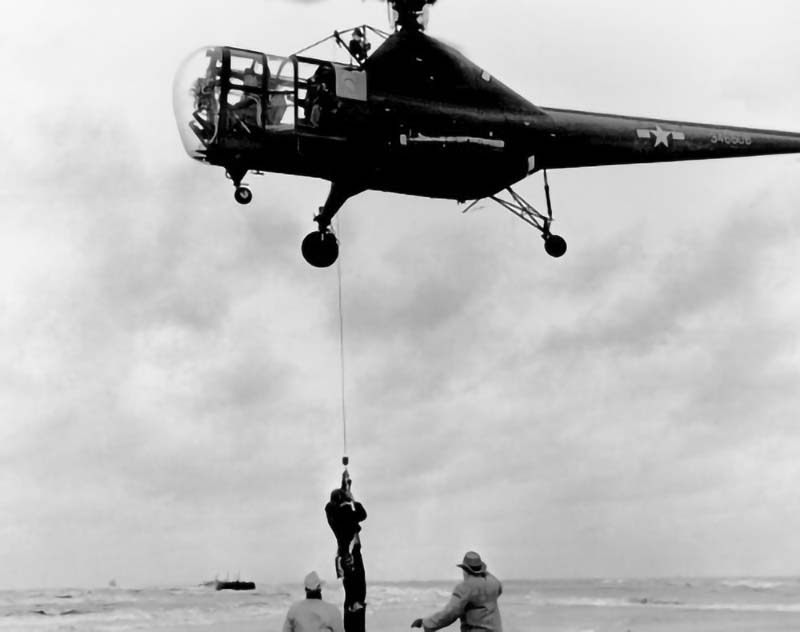
During the night, the two men on the barge, Captain Joseph Pawlik and crewman Steven Penninger, huddled in the cabin and wondered if anyone had seen the flares they had set off. As dawn broke, the storm became even more violent and giant waves were methodically stripping away the barge’s deck and superstructure.
On Fairfield Beach, a group of townspeople who had seen the flares joined policemen to watch the scene, all of them helpless to do anything to save the men on the barge. Then someone had a thought: the Sikorsky Aircraft Company was nearby, in Bridgeport, Connecticut.
“The police called us and said the barge was in a hell of a shape and asked if we could do anything,’ said Dmitry “Jimmy” Viner in 1995 at age 87. “I said, ‘sure could.”
Jimmy Viner was a legend at the Sikorsky Aircraft Company. At age 15, he had followed his uncle Igor I. Sikorsky to America and went to work as one of the company’s first employees. Eventually Viner became the company’s chief test pilot and was also known as the first helicopter pilot in the world to log 1,000 flight hours.
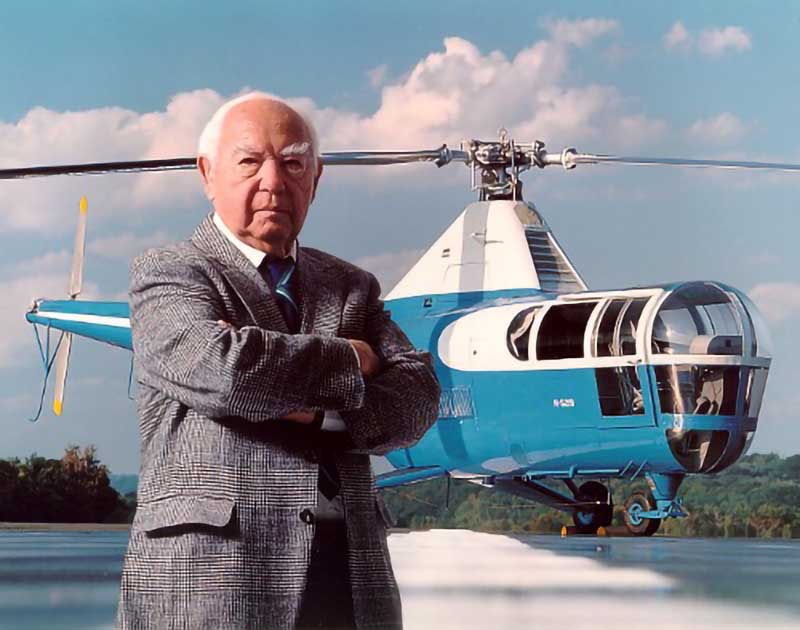
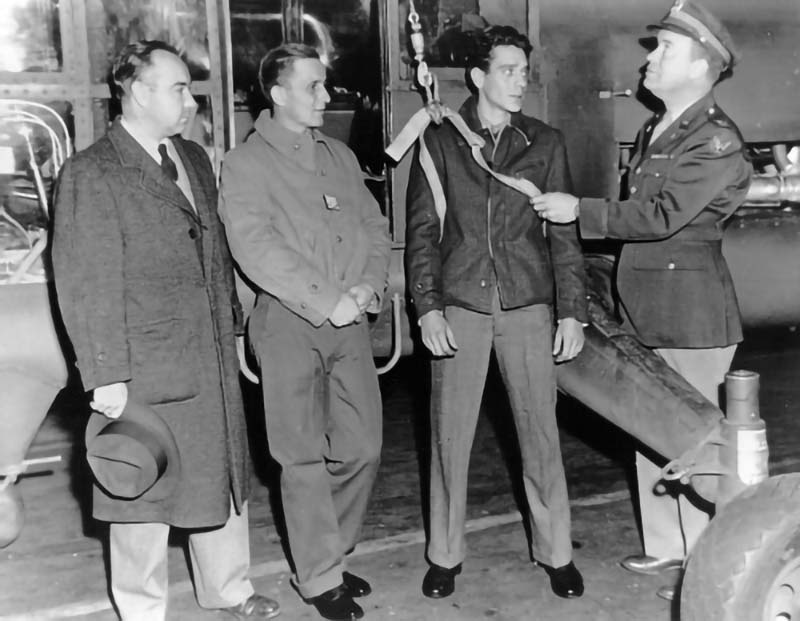
When the call for help came, the then 36-year-old Jimmy Viner called over his friend, Capt. Jackson E. Beighle who was an Army Air Force representative at Sikorsky. They jumped in the first available helicopter, and with Viner at the controls, they were hovering over the crippled barge within minutes. From the helicopter, they watched as one of the men on the barge came out of the cabin and set off a red flare. They dropped a rope with a weight and a message asking how bad it was down there. In a few minutes, they pulled up the message bag containing the return note. It was very bad: Eight tanks were leaking, the cabin was full of water, and the two men were afraid the barge would break up.
The two men in the helicopter now knew what they had to do. Back at the Sikorsky factory was a Sikorsky R-5 helicopter, a model that first flew two years earlier as an observation and rescue aircraft. The helicopter had been equipped recently with a hydraulic hoist for experimental purposes. The idea of pulling someone out of danger by a cable from a helicopter was a new concept. Only three months before, the Coast Guard held a public demonstration of the hoist at its helicopter facility at Floyd Bennett Field in Brooklyn, New York.
But the concept had never been tested in an actual crisis. Now, unexpectedly, the hoist and the helicopter were going to be put to the ultimate test. If both did not function correctly, two men might die. However, if the rescue was not attempted, they might die anyway. The helicopter crew really had no question about what they should do next.
Viner quickly flew the first helicopter back to the Sikorsky plant and the R-5 with the hoist was readied for flight. “We had to get a rotor blade that had been taken off it and stored but we got it ready in a very short time,” Jimmy Viner recalled. In a matter of minutes, the R-5 was hovering over the barge, dropping a note that Capt. Beighle had scribbled, telling the men below to get into the harness that was going to be lowered. The harness was a simple device that looped under the arms. Each man would have to hold onto the cable over his head; otherwise, he would drop out of the harness.
It worked. The first man, Penninger, was lifted quickly out of the swirling waters on the barge. But there wasn not enough room for him inside the helicopter’s two-seat cabin. He was transported to the beach half-inside and half-outside the cabin, hanging onto Beighle while Jimmy Viner fought the winds.
The experience for the second man, Pawlik, the barge captain who had observed the tradition of the sea in being the last to leave his ship, was much more frightening. He was being lifted when suddenly the hoist jammed, leaving him hanging 30 feet below the helicopter. And in that position, holding onto the cable for dear life, he was transported to shore in winds so fierce that the sand on the beach was blowing up in sheets.
It was a sight cheered by the people on the beach and captured on film by a news photographer. The next day, newspapers all over the country and the world carried the picture of Pawlik hanging in the air, heading for safety.
Immediately following the rescue, Jimmy Viner made the following report of the R-5 helicopter’s performance in the weather conditions: “It was raining during this flight with northeast winds from 30 to 60 miles per hour and extremely turbulent air. The wind was so strong that the wet sand was blowing on the beach. In spite of these facts, it was possible to hover the aircraft accurately enough over the barge to enable both men to get into the hoist harness without any difficulty. I believe,” Viner concluded, “that the above facts could always be cited in any discussion where controllability and precision flying of this aircraft are questioned.”
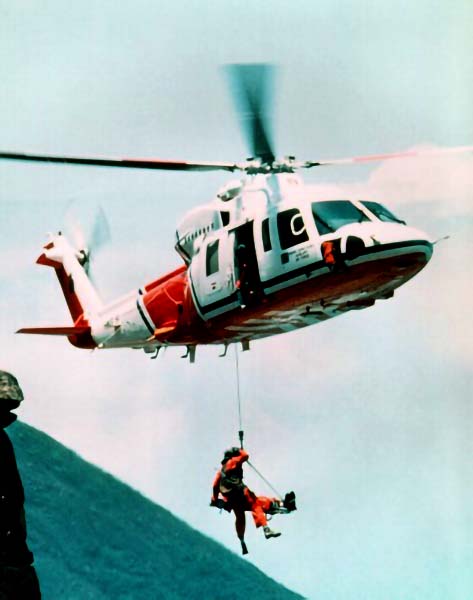
The helicopter hoist rescue that occurred for the first time on that stormy day at Penfield Reef cemented the helicopter’s role as a rescue vehicle to save the lives of victims in disaster situtations, especially when areas are inaccessible by other types of vehicles. In the 80 years since, countless lives have been saved in helicopter hoist rescues, from sinking ships, earthquakes, highway accidents, landslides, volcanic eruptions, fires in tall buildings, military conflicts, and other disasters.